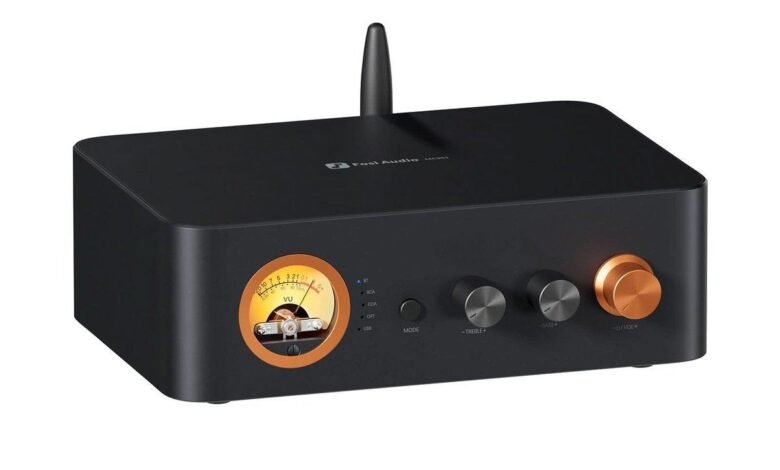
Music listening has changed. Where a hi-fi system once revolved around discs and vinyl, it now revolves around streaming: playlists from a phone, high-resolution files from a computer, and internet radio from a small box beside the television. The integrated amplifier has changed with it, and the modern version is built for the streaming age, with digital inputs, Bluetooth and a built-in DAC at its core.
The DAC Inside Your Amplifier
A DAC, or digital-to-analogue converter, turns the digital data of a stream or a file into the analogue signal your speakers can reproduce. Every digital source needs one, and the question is where it lives. In a modern integrated amplifier, the DAC is often built in, which means you can connect a television, a streaming box or a computer directly, with no extra box in between.
A built-in DAC keeps the system simple and the signal path short. It also means the amplifier’s designers have chosen a converter that suits the rest of the circuit, so the result is coherent and easy to live with.


Digital Inputs That Matter
When choosing an integrated amplifier for streaming, check its digital inputs. An optical input connects most televisions and streaming boxes, while a coaxial input suits digital sources with that output. A USB input is the most flexible for a computer, because it carries the digital signal directly and often supports higher-resolution files.
Each input has its place, and the right combination depends on your sources. List the devices you actually use, and make sure the amplifier has an input for each one. A missing input is the most common regret in a streaming setup.
Bluetooth: Convenience Without Compromise
Bluetooth is the most convenient way to play music from a phone or tablet. Modern versions of Bluetooth sound far better than early ones, and for casual listening, playlists in the kitchen or background music while you work, the convenience is hard to beat.
For serious listening, a wired digital connection still has the edge, because it avoids the compression Bluetooth applies. The best approach is to use both: Bluetooth for convenience, and a wired connection when you want the best possible sound.
Streaming Services and Sound Quality
Streaming services offer different levels of sound quality, and your integrated amplifier will reproduce whatever you send it. Some services offer a free tier with advertisements, while paid tiers remove the interruptions and often unlock higher sound quality as well. It is worth comparing what each service offers at each tier, and choosing the one whose catalogue and quality suit the way you listen. A good amplifier makes the differences between services and settings audible, which is a reason to choose a service tier that suits your ears and your system. The amplifier itself does not care where the music comes from; it simply plays it as well as it can.
5 Features to Look For in a Streaming-Ready Integrated Amplifier
- A built-in DAC, so digital sources connect directly.
- Optical and coaxial inputs for televisions and streaming boxes.
- A USB input for high-resolution playback from a computer.
- Bluetooth for quick, cable-free listening from a phone.
- A headphone output for private listening late at night.
Keeping the System Simple
The streaming age rewards simplicity. An integrated amplifier with a built-in DAC, a few digital inputs and Bluetooth can be the entire heart of a system: sources connect directly, the amplifier handles everything, and the music plays. There is no stack of separate boxes, no tangle of interconnects, and nothing to configure beyond choosing an input.
That simplicity also makes the system easy for everyone in the household to use. Anyone can open an app, choose a song and hear it through proper speakers, which is the point of a hi-fi system in the first place.
High-Resolution Streaming: Is It Worth It?
High-resolution streaming promises more detail than standard quality, and on a good system the difference can be audible, particularly in acoustic music with quiet passages and natural decay. Whether it is worth paying for depends on your system, your ears and your listening habits.
An integrated amplifier with a built-in DAC and a USB input is ready for high-resolution files, so you can try a higher tier for a month and judge for yourself. If you hear the difference and value it, keep it. If you do not, standard quality through the same amplifier still sounds excellent, and you have lost nothing by checking.
Frequently Asked Questions
Do I need a separate streamer with a modern integrated amplifier?
Not necessarily. If your television, computer or phone can send music to the amplifier, you already have a source. A dedicated streamer is an optional upgrade for convenience or higher-resolution playback.
Is Bluetooth sound quality good enough for hi-fi?
For casual listening, yes. Modern Bluetooth sounds perfectly enjoyable through a good system. For critical listening, a wired digital connection is still preferable.
Can I connect my television to an integrated amplifier?
Yes, in most cases. An optical cable from the television to the amplifier’s optical input is the usual method, and it is a large improvement over built-in television speakers.
See also: Everything You Need to Know About Techidemics.com
Final Thoughts
The integrated amplifier has adapted to the streaming age without losing what made it appealing: one box, simple to use, ready to play. With a built-in DAC, digital inputs and Bluetooth, it connects your modern sources to your speakers with the minimum of fuss. If your music now lives on a phone or a computer, an integrated amplifier built for streaming is the natural heart of your system, and it will keep pace as the way you listen continues to change in the years ahead.