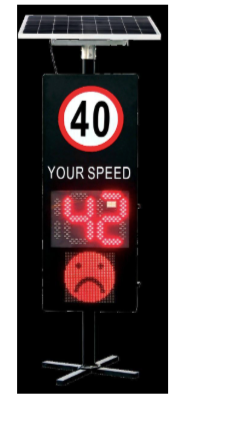
Most drivers glance at a speed display for less than a second. In that blink, a number has to be read, compared with the limit, and judged. A radar speed sign with face feedback skips the arithmetic: a smiling face means you are within the limit, a warning face means you are not. That instant emotional cue is why more towns are choosing signs that smile back.
This article explains the psychology behind face feedback, what the hardware looks like, and where it works best. Drivers respond to faces as they do to people, and a frown from a sign carries a weight no bare number can match.
How a Face Delivers the Speed Message Faster
Humans are wired to read faces. A child can tell a smile from a scowl long before it can read numbers. A driver feedback sign showing a face taps into the same reflex. The driver does not need to know the limit, read the digits, and do the subtraction; the face answers the only question that matters: am I okay, or am I not?
- Faces are recognised before words or numbers are decoded.
- A smile or warning face needs no language and no maths.
- The emotional cue creates a small moment of pride or embarrassment.
- That feeling sticks, so the driver remembers the sign next time.
Why Symbols Beat Numbers for Many Drivers
A number only works if the driver can read it, knows the limit, and does the comparison. A symbol has no such conditions: a smiling face is understood in every language and at every age, which is why a your speed sign that pairs digits with a face reaches drivers a bare number misses. The face also adds social pressure: nobody wants to be the driver the sign is frowning at.
- Visitors who do not know the local speed limit.
- New drivers still building speed judgement.
- Drivers passing through an unfamiliar neighbourhood.
- Anyone glancing at the sign for under a second.
- Drivers who ignore plain number displays.
What the Face Feedback Display Looks Like
The hardware behind the smile is a purpose-built dynamic speed display. A 24 GHz Doppler radar unit measures each approaching vehicle, detecting 10 to 250 km/h to plus or minus 1 km/h, and the sign reacts within a fraction of a second. The face sits on a P10 module measuring 320 by 320 millimetres, bright at 8000 candela per square metre or higher and readable in direct sunlight, with 3M reflective film adding visibility after dark. Beside the face, a red and green LED speed display shows the measured speed: green within the limit, red once it is exceeded, with a maximum displayed speed of 199.
See also: Pillow Plate Laser Welding Machine Applications in Food, Chemical and Energy Industries
Where Face-Feedback Signs Work Best
Face feedback shines where drivers need a nudge rather than a penalty. A school zone radar speed sign greets parents and commuters with a smile when they slow down, and the evidence backs the approach: Texas Transportation Institute research found school-zone average speeds fell 18 percent, from 50 mph to 41 mph, where radar speed signs were installed. Residential streets, village entries, and rural curves benefit the same way.
- School zones, where the smile rewards careful parents.
- Residential streets with children playing nearby.
- Village and town entries where limits drop suddenly.
- Rural curves with a history of run-off crashes.
- Hospital zones with vulnerable pedestrians.
Setting Up a Face-Feedback Sign for Best Results
Placement decides whether the face is seen in time. Mount it where approaching drivers have a clear view for the full detection distance, and set the speed threshold configuration to match the posted limit so the face changes exactly when the law does. Solar models run on a 60, 80, or 100 watt panel with battery backup for 7 to 10 days of rainy weather. Weekday and weekend on-off scheduling lets a school-zone sign rest when the school is closed.
- Confirm the threshold matches the posted speed limit.
- Check the face is visible from the detection distance.
- Angle the solar panel for maximum sun.
- Set weekday and weekend schedules for school-zone sites.
Measuring Whether the Smile Is Working
The evidence is in the data. Models with speed data logging record every passing vehicle, so a town can compare speeds before and after installation. The FHWA demonstration found effects held for 24 months, and Montana State University recorded 5 to 10 percent speed reductions on rural roads. If the share of smiling faces rises week by week, the sign is doing its job.
- Average speeds fall in the weeks after installation.
- Fewer vehicles trigger the warning face over time.
- Speeds stay lower months later, not just in week one.
- Residents report calmer traffic on the street.
Frequently Asked Questions
How does a face-feedback radar speed sign work?
A Doppler radar unit measures each approaching vehicle. The sign shows a smiling face within the limit and a warning face over it. A red and green LED display shows the measured speed alongside the face.
Is a face-feedback sign visible in bright sunlight?
Yes. The face module uses a P10 LED display with brightness of 8000 candela per square metre or higher, and 3M reflective film keeps the sign visible after dark.
Where are face-feedback speed signs most effective?
They work best in school zones, residential streets, village entries, and rural curves, where most drivers are willing to slow down and only need a clear, instant reminder.
Do face-feedback signs need mains power?
No. Solar models run on a 60, 80, or 100 watt panel and can keep working for 7 to 10 days on battery through rainy weather, and a mains option is available where a power supply is handy.
Final Thoughts
A smiling face is the oldest traffic signal there is: approval for doing the right thing. A radar speed sign with face feedback puts that human instinct to work on the roadside, turning a speed reading into a moment of connection. For towns that want calmer streets without penalties, the smile may be the most persuasive sign they ever install.